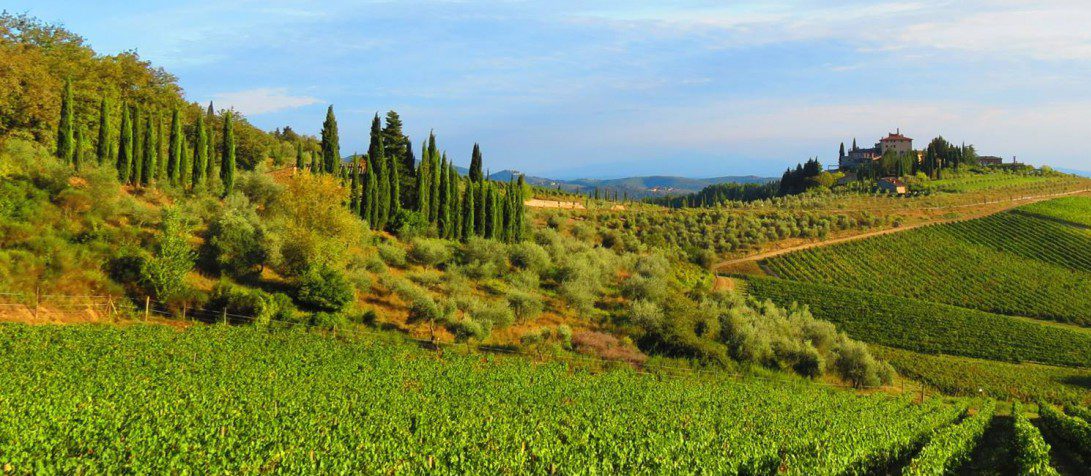
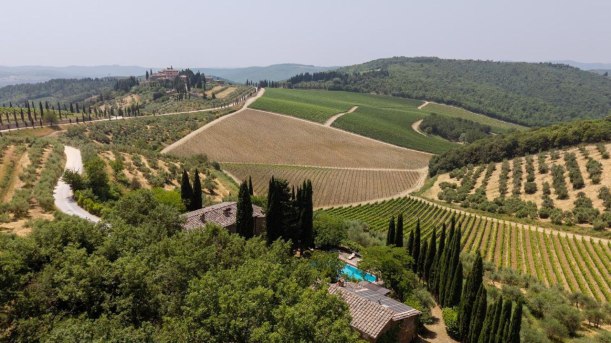
Imagine staying in an authentic Tuscan home surrounded by a landscape straight out of a Renaissance painting: rolling hills, endless vineyards, and ancient olive groves.
Prime Location
Gaiole in Chianti (just 3 km from Radda in Chianti, 30 km from Siena, 40 km from Florence)
La Casa di San Donato in Perano is a classic Chianti farmhouse whose central core dates back to the 11th century, with origins tracing even further to the Etruscan-Roman era. Lovingly and tastefully restored by Marisa Marino in Forcheri (died in 2012), with the help of her daughter Paola, and further enhanced since 2014 by her daughter Nicoletta, this residence beautifully blends historic charm with modern comfort.
Nestled in a delightful garden among centuries-old olive trees, the house features a panoramic 12×6-meter swimming pool and furnished terraces perfect for al fresco meals, sunset dinners, and moments of pure relaxation with breathtaking views over the Chianti Classico countryside.
Historically part of the San Donato in Perano Castle estate (of which it was a traditional farmhouse), the property is described in the book San Donato in Perano by Francesca Marchetti and Donatella Tognaccini (Ed. Polistampa, 2007):
️The toponomy of San Donato in Perano was mentioned for the first time in November 1112 in a reference to a sale of plots of land in San Donato in Perano to the Badia di Coltibuono by the married couple Anselmo and Parenza. In the second half of the 12th century, the location was mentioned as a boundary in a donation of land and assets for the same monastery.
 La Casa di San Donato in Perano